ArticlesFees9 min read
How to set a school fee structure in Pakistan that does not fall apart in March
Most fee disputes are not about money. They are about a structure that was never written down in one place.
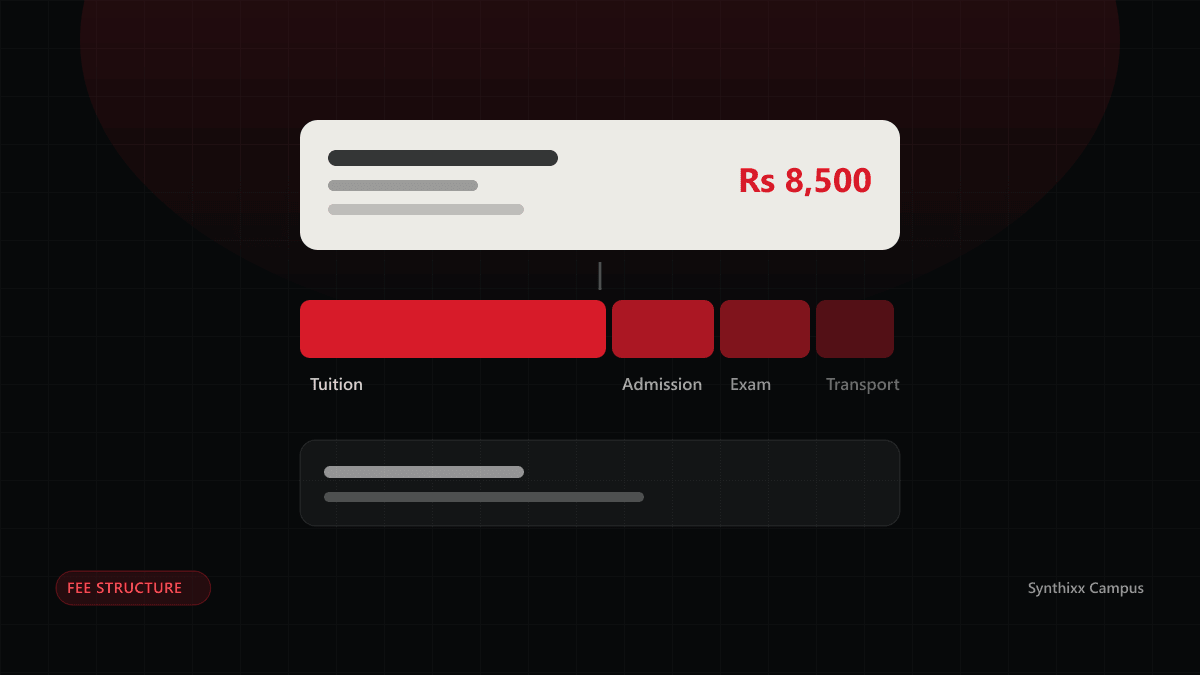
Almost every fee dispute a school has in March was created in August. Not by the amount — by a structure that lived in three places: a printed list for parents, a spreadsheet in the office, and one person’s memory of which families were given what. By the middle of the session the three no longer agree, and the argument that follows is never really about money.
This is how to set the structure up once so it still adds up in month seven.
Start with heads, not a total
A single number on a challan is a promise you cannot explain. Break the fee into named heads and the conversation changes completely — you can raise transport without appearing to raise tuition, you can waive one charge for one family, and a parent asking “what is this for” gets an answer instead of a defence.
- Tuition — monthly, the bulk of it.
- Admission — once, on joining. Not every year.
- Annual or development charge — yearly, usually at the start of the session. This is the one parents confuse with admission; name it plainly.
- Examination — per term or per board exam, if you charge it separately.
- Transport — by route or zone, because distance is the cost.
- Anything else you actually charge — lab, library, uniform, stationery. If it appears on a challan, it deserves a name.
Set the amount per class and per campus
A school with two branches almost never charges the same in both, because the areas are different and the costs are different. If your system only holds one fee per class, somebody will be editing numbers by hand every month, and that is where the errors live. Decide the amount for each class in each campus, once, and let the monthly generation read it.
Write discounts down as discounts
The usual shortcut is to quietly charge a sibling Rs 4,000 instead of Rs 5,500. It works until the family asks what the discount was, or the person who agreed it leaves, or you want to know what concessions cost the school this year. Record the full fee and the discount against it. The challan then shows both, the parent sees what they were given, and the arrears list is still arithmetic rather than folklore.
Generate the month, do not type it
Typing challans one by one is where a month goes. The structure above exists so that generating a month is a single action: every enrolled student gets the fee for their class and campus, with their discounts applied, on the same day, with the same due date. What the office does afterwards is handle the exceptions — a new admission mid-month, a leaving student, a family in difficulty — which is work that actually needs a person.
Record what arrived, not what was expected
Fees arrive by JazzCash, EasyPaisa, bank transfer and cash at the counter, often for the same family in different months. Whatever the method, record the amount that actually arrived, the date, the method and the transaction number, against one student and one fee. Three rules follow from that:
- A part payment is a part payment. The balance stays outstanding, visibly.
- Every record keeps the name of the staff member who entered it. Not out of suspicion — because in March somebody will need to ask.
- A receipt is produced at the moment of payment, not reconstructed later.
The arrears list is the test
You will know the structure is right when the principal’s morning arrears list and the accountant’s working file are the same list. If they differ, it is almost always one of three things: a discount that was never written down, a part payment marked as paid, or a fee generated twice for a student who moved class. All three are structural, and all three are fixable in August and miserable in March.
What this looks like in practice
In Synthixx Campus the heads and amounts are set per class and per campus once, the month is generated in one action, discounts are recorded on the student’s fee, and payments are entered with the method and transaction number by whichever staff you give the accountant role to. Parents see their own fees — paid and unpaid, this month and last year — in their portal, which removes most of the phone calls the office was fielding. The arrears list is calculated from the actual charges and payments, so there is only ever one of it.
You can try the whole thing on a school full of data in the live demo, without making an account.
Questions
What is a fee head?
A named charge that appears on the challan — tuition, admission, annual charges, examination, transport, lab, library. Keeping them separate is what lets you answer "what is this Rs 8,500 for" without opening a drawer, and what lets you raise one without raising the rest.
Should admission fee be charged once or every year?
Admission fee is charged once, on joining. The yearly charge most schools mean is the annual or development charge, and calling it "admission fee" every August is the fastest way to start an argument with a parent who remembers paying it.
How do we handle a sibling discount?
Record it as a discount on the student's fee rather than by quietly charging a smaller tuition. The challan then shows the full amount and the discount, the parent can see what they were given, and the arrears list still adds up.
Can different branches charge different amounts?
They usually must. Set fee amounts per class and per campus so class 1 in one branch and class 1 in another can differ, and so a monthly generation does not flatten them into one number.
What is the right way to handle a part payment?
Record what actually arrived, against the right fee, with the date and the method. The balance stays outstanding. Writing "paid" because most of it came in is how a school loses the thread by March.
How far back should fee records go?
Keep them for as long as the school exists. Old fees and payments should stay searchable and reprintable — a parent asking for a 2024 receipt is an ordinary request, not an archaeology project.